Your Whole Home Paint Planner & Interior Paint Guide
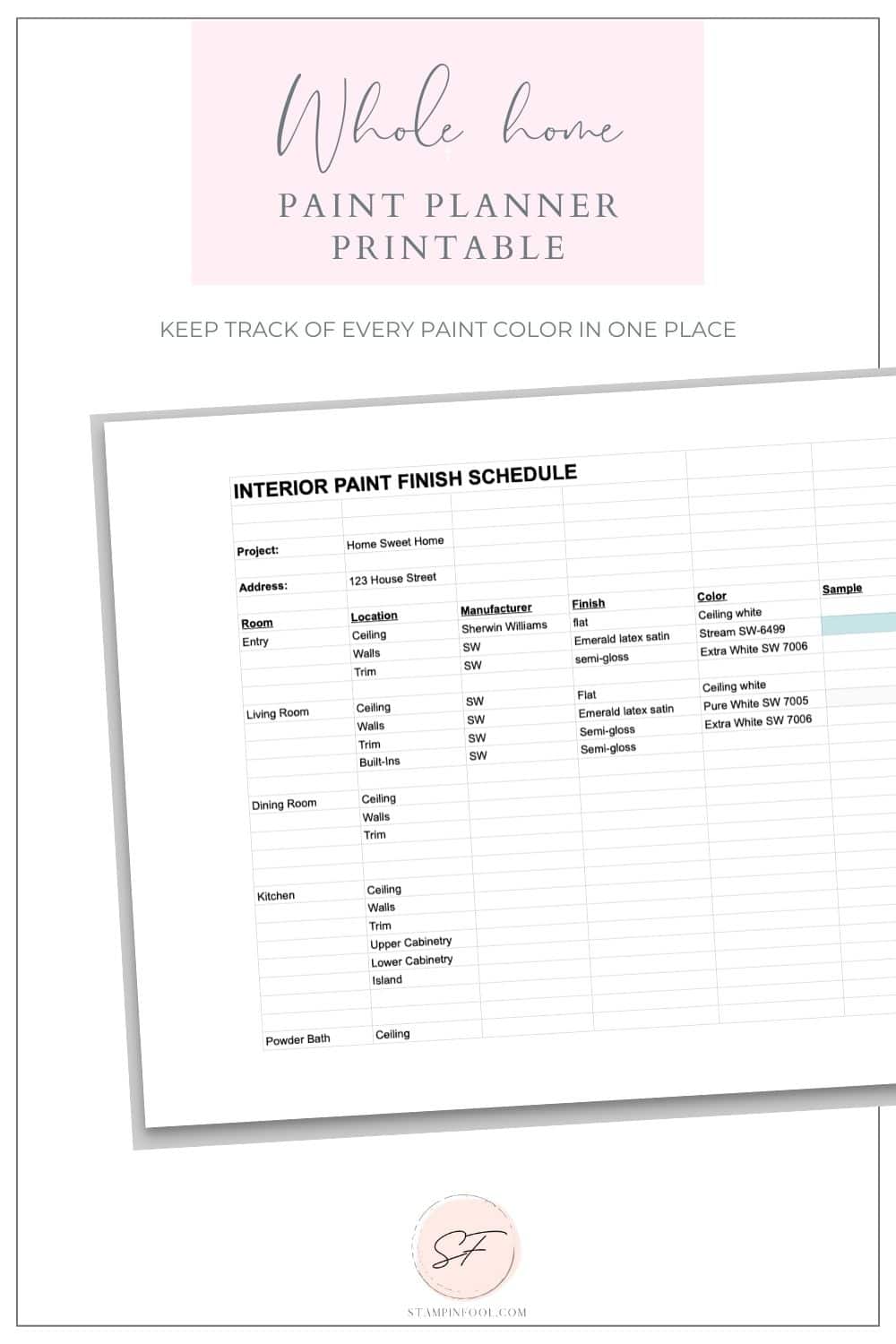
Use this FREE printable Whole Home Paint Planning worksheet to keep track of every paint color in every room of your house!
Are you thinking about repainting your entire home, or even just a room or two? You’re going to want to save a copy of this paint planner so that you can keep track of the paint color used in every room.
Snag our free printable to never forget which color is painted in what room!
WHAT IS AN INTERIOR PAINT COLOR & FINISH SCHEDULE?
First, let’s address the word “finish”. It can refer to either the sheen (flat, satin, semi-gloss, etc.) or to the specifications and details in construction, i.e. the faucet color (finish) or the paint color or tile you’ve chosen. It’s kind of a an industry term, but you’ll likely hear it used by your contractor.
Here we will use “finish” both ways. The “finish schedule” will refer to the list of paint color used in the project (your home). And we will also use the word finish, as a column on the paint schedule to refer to the paint sheen you’ve chosen.
THE PAINT SCHEDULE
What is a paint schedule? Paint schedule is a fancy way of saying list, specification, spreadsheet, detail- a listing of every room in the house paired with the detailed information about the paint brand, color, finish and location that will be used.
We’re going to cal it a “planner” here since schedule is more of an building/design industry term.
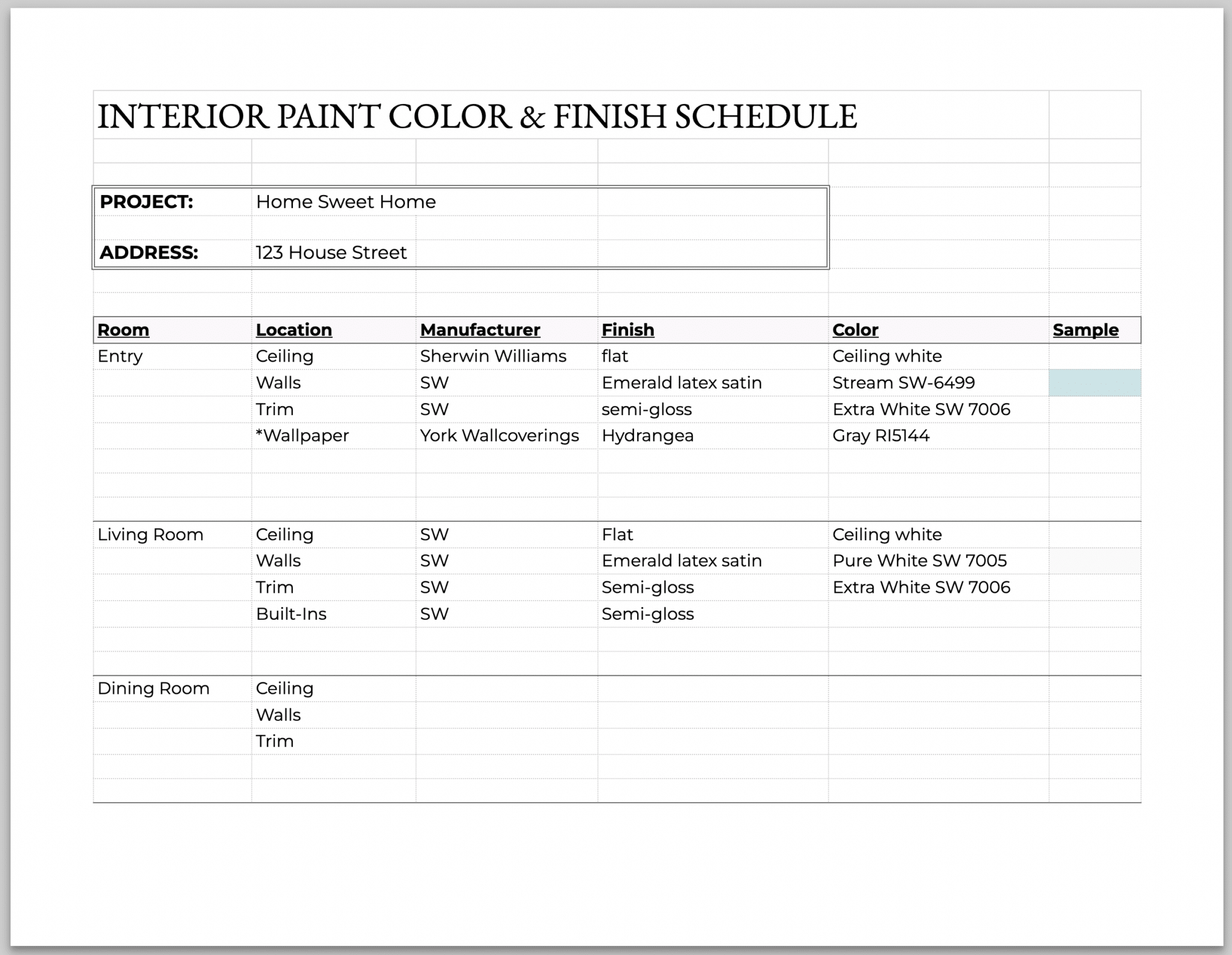
You can use this paint color spreadsheet to track: the room, the application location- wall, ceiling and trim choices, the paint manufacturer, the finish (sheen), and the specific color and paint number, as well as a color swatch. [See graphic below]
DOWNLOAD PAINT PLANNER HERE
Directions: Click link > Go to File > Make a Copy > Click OK.
Now you can edit the google document.
Or click here to download the Excel version:
HOW TO USE THE INTERIOR PAINT PLANNER / FINISH SCHEDULE
First, use these directions to download the spreadsheet as a google document or Excel spreadsheet.
Directions: Click link > Go to File > Make a Copy > Click OK.
Next, fill in the project name and address.
COLUMN 1: ROOM
List the room and you can modify or add rooms to the bottom as needed. If you remove rooms, make sure you remove the entire row, not just the first column.
COLUMN 2: PAINT LOCATION
The featured location for each room is the place the paint will be added- there’s a difference between the ceiling, walls, and trim so you can track it accordingly.
For example, if your living room has a fireplace that will be painted, you will add a line for “fireplace”.
In addition, if the room will have different colors on walls, you will specify each wall individually. The same goes for doors. I have listed trim to include doors, but if the doors will be a different color, you will need to add “doors” to column 2.
COLUMN 3: MANUFACTURER
The next column is where you will list the paint manufacturer information. While you may mostly choose the same manufacturer for each room, you may find a color or style of paint from another company that you fall in love with and want to use, such as Farrow & Ball or Fine Paints of Europe.
COLUMN 4: PAINT FINISH
Paint finish. In column four you will specify that paint sheen. Additionally, I like to include the specific product so there is no confusion if I need to reorder or repaint later.
It keeps it really clear and organized for both yourself and as an amazing resource for your buyer if you ever sell. Just think how happy you would be to buy a freshly painted house, with colors you love and have the guide to every finish and color handed to you!
COLUMN 5: PAINT COLOR & CODE
The most fun column of them all is the color specification. Here you should include both the color name and manufacturer assigned number so that there is no confusion.
This is helpful if you accidentally jot down the incorrect color name or a color name that is used in multiple brands, the number will help you identify which one it is when you need to touch up paint in two years.
COLUMN 6: PAINT SAMPLE
In the final column there is space for the paint sample. You can either include a paint chip, or an approximate color to represent the color family (blue, red, green, etc.). This may not be as helpful if your colors are very similar, but it adds a layer of confirmation.
GENERAL TIPS FOR USING AN INTERIOR PAINT SCHEDULE OR PAINT PLANNER
Lastly, I will leave you with a few general tips to make the most use out of your whole home paint planner. Tracking all of this information will be immensely helpful over the life of your home ownership.
- Print out a blank copy and jot down the colors or finishes you think you may use. Use it as a working tool to plan your entire color palette.
- Keep a copy with your paint cans.
- Give a copy to your painter to keep everything straight.
- I also recommend posting the paint schedule to the door of each room with the room info highlighted. This is especially helpful for a new build or when multiple rooms have been hired out.
- Include a copy with your sales package when you list your home on the market. This is an invaluable resource for a new buyer.
- Make additional notes if you end up disliking a color or finish.
- Take the paint schedule to the paint store with you while ordering paint.
PAINT FINISHES
Before we wrap this up, let’s briefly talk about paint finishes. I tend to prefer certain finishes for walls versus trim. And there are a few finishes I NEVER use.
So let’s get into it. I will list the finish (sheen) and then the areas I would use it.
High Gloss
I love to use high gloss when it can be sprayed. But, if you have a great painter that does exceptional prep work. Use it on:
- trim
- built in bookcases (floor to ceiling)
- exterior doors
- lacquered ceilings
- CONS: it shows every spec of dust and imperfection, dent, texture so smooth walls/surface are important for high gloss to look it’s best
Semi-Gloss
- this is the most common trim choice
- built in cabinetry to match trim
- kitchen cabinets
- stairs & rails
- interior doors
- dark, bold colors (to bounce light around)
- CONS: shiny finishes so imperfections, so good prep work is needed; I don’t typically use it on walls
Satin
- walls
- trim
- cleans well & can be touched up without showing huge marks
- PRO TIP: you can use satin on trim and walls for a more modern look with better durability than flat
Eggshell
- NEVER
- I never use an eggshell finish because you cannot touch up a spot with an eggshell finish. It will show, you must repaint the entire wall.
- Instead opt for satin or a super flat (meant for durability & cleaning)
Flat
- Ceiling paint
- There is super durable contractor grade flat paint on the market now at major retailers (ask your paint store)
- Use flat on walls where you don’t want high reflection
- Flat looks great for dark paint colors, especially Sherwin Williams Emerald line
- Touches up easily
FREE INTERIOR PAINT SCHEDULE DOWNLOAD
DOWNLOAD PAINT PLANNER HERE
Directions: Click link > Go to File > Make a Copy > Click OK.
Now you can edit the google document.